


Reverse Strategy: Decreasing Contribution Percent
After my husband read our net worth update, he asked why our portfolio was declining and if contributions wouldn’t offset the declines. I explained that we had reduced our savings contributions significantly in the last few years, which alarmed him.
Actually, the strategy I came up with is anything but alarming. Here’s an example of how it works. We’ll use the following data points for the illustration:
- Starting salary for couple: $100,000
- Salary increases per year: 4%
- Yearly return on portfolio, compounded annually for simplicity: 8%
- Time frame: 25 years
- (We’ll ignore inflation for this exercise)
Static Contribution Percentage
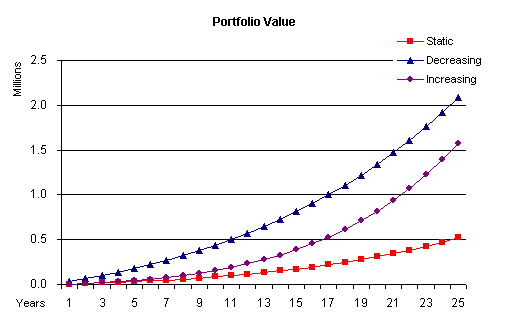
Typically, someone will select a contribution percentage for their retirement plans. We’ll use a 5% contribution. Often years go by and the percentage remains static. The great part here is that the individual is saving. In our example the couple will have saved $523,000 after 25 years!
Increasing Contribution Percentage
One of the popular methods for saving for retirement is to increase your contribution percentage each year. Timing it with your raise often means you won’t notice a decrease in your take-home pay. This is a terrific model for saving for retirement and yields a substantial gain over the static model.
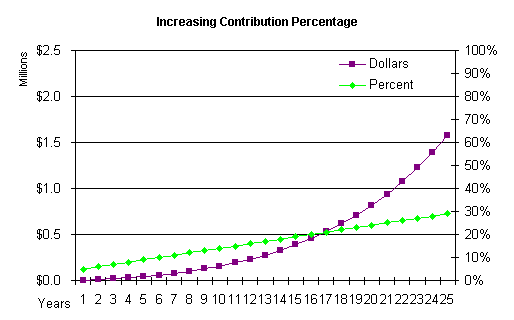
Increasing the contribution by 1% each year will yield over $1,000,000 after 22 years. In addition, after 25 years the portfolio will be worth $1.6 million! Here’s a graph showing the savings percent plotted against the portfolio value.
Decreasing Contribution Percentage
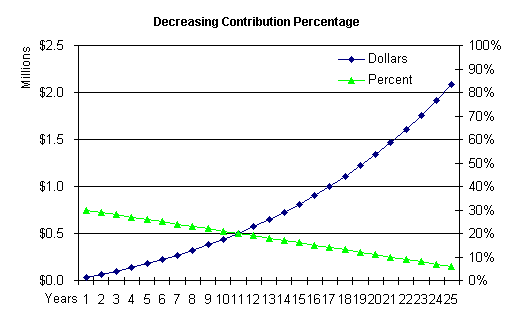
A strategy that doesn’t get a lot of thought is one that reverses the common increasing contribution percentage. Starting the percentage out very high and decreasing it by 1% each year yields much more than the increasing percentage strategy.
If the couple starts at 30% and decreases their contribution by 1% each year the portfolio will hit the $1 million mark after only 17 years. In addition, the portfolio will be worth $2.1 million after 25 years.
The total contributions for this example were actually less in total than the increasing model ($133,000 less). In addition, with this strategy, there is the ability to stop contributions all together at some point in the future, as they eventually become irrelevant in terms of relative value.
Comparison
Here’s a graph showing the three different strategies and the portfolio values over time.
Our Strategy
Having been a saver since I was a kid I started us on an incredibly aggressive savings plan. We contributed over 50% of our salary to our retirement portfolio from the start. We then backed it down to 40% when we started building our new house. After we had kids is went to 25% and just recently we lowered it to 15% for our 2008 budget.
It was very easy to save aggressively in the beginning because we didn’t have huge financial commitments that often come a little later in life (mostly a house and kids). Now that we don’t have a big need to save much anymore we can direct some of that money towards other things.
Of course, we still save a high percentage of our income when comparing it to other families.
How are you saving for retirement?
This article is featured in: Carnival of Personal Finance #143.


We’ve definitely used the increasing method. Unless you opt out of it, my company automatically enrols you in an increasing % on my 401k. We’re currently saving 17% (max 401k), with hopes to save more via IRA.
Thanks for sharing this strategy. How much though has truly been strategy and not just life getting in the way?
This only works if you have the insight to save when you’re young. I think I’m there, but a lot of people aren’t (and, unfortunately, most of the late savers probably don’t read your blog).
Great post! The importance of making contributions early on cannot be emphasized more due to the power of compounding interest. I’ve found your dollar plan inspiring. That, along with a recent conversation with my husband has prompted me to my thoughts on where we should be financially from now until we’re 100 down on paper. Well actually it’s in Excel – much easier to calculate returns and cashflow that way!
That’s a really neat method that I’d never considered. Granted, it only works for a few people (the young ones!).
It’s a little late for me since I already have the mortgage and the kids are coming soon, but we can all teach this to our kids and they can implement it!
I’m another one of the increasing people. I just have more money now, and of course more public accountability with my finances .
.
Interesting. I increase, because I already contribute the most I can afford for now. I’m still working on other tasks many in their 20s have to think about–saving for home down payment, student loans, and building up an efund.
Really though provoking!
I have plans to drop every new raise into retirement/debt. Have to look at the model.
Thanks,
Noel
@ PT: Our company is starting the automatic enrollment and opt out plan next year. I think it’s a terrific idea! As far as strategy versus life… it’s a little of both. We planned to decrease it some, but actually decreased it faster based on some of our spending. Luckily, it will have little impact.
@ Lily & calgirl: If only I had a way to show each college graduate these graphs! I’m glad to hear there are others out there who are also starting young!
@ Becky: Great plan to teach to your kids!
@ plonkee, Sjean, and Noel: Good to hear you are all increasing your contributions. Your future selves will be glad you did!
An even better strategy is the one I’m doing with my two kids – start investing relatively small amounts into their retirement accounts from when they’re born and they’ll probably never have to worry about saving for their retirement during their working lives. In Australia the money put into retirement (superannuation) accounts is locked away until retirement age, so an added benefit of this method is that you can use their investments to teach them about saving, compound interest and asset allocation, but they won’t be able to cash out the investment and buy a sports car when they turn 18!
My strategy is just to set a minimum floor on contributions, which is 20%. Then, whatever money I have left over gets saved in a taxable account. I’m a pretty frugal guy so I usually end up saving in the 30-40% range. For me, the problem with setting a firm contribution limit is that it makes me more likely to spend any extra money I have at the end of the month foolishly since I’ve already hit my target.
@ Enough Wealth: What a great idea! We aren’t allowed to use retirement accounts here in the US unless the kids have earned income, but I will be encouraging them as soon as they have jobs.
@ Kyle: I like the minimum floor. How long have you been saving at the 30-40% range? At that rate, you’ll be retired in no time!
A little of both. We started off investing a good portion, but certainly not 50%. As we realized we planned on having children, we put away much more than we previously did. When we have children we will go down to one salary, so we will be moving toward the decreasing end.
We have put away a nice sum, so I will say more toward the decreasing model. Very nice article!
That’s quite interesting. I’ve been putting in 15% for about ten years, since my late 20s (actually do 16% now to get my full 4% match). I’ve wondered if I could choose to scale back, especially when the interest earned/reinvested eventually outpaces my contributions! But I’m just going to stay the course of 15% and focus on getting cash in the bank for non-retirement savings.
In the US, retirement plan contributions are based only on work income. If you can pimp out your kid for baby/child modeling jobs, stick their earnings (to the annual cap.) in a Roth IRA equity investment. However, they will be able to raid it later–that’s a danger. Of course, you could keep the account a secret from them until they’re retirement age. LOL
Another way to do it, regardless of work income, is a RIC-E trust. (“Ricky” trust) — Stands for Retirement Income for Everyone, a patented product by Ric Edelman. For a trust setup fee of a few hundred dollars, you can set up a locked-up (no raiding) retirement investment account for babies/children and use the power of time to make them rich. Brilliant idea. Patented product invented by Ric Edelman, one of the top independent financial planning firms in the USA.
http://www.ricetrust.com/
So if a parent or grandparent is flush with cash, and has it to spare without sacrificing their own lifestyle, set up a RIC-E trust for each child/grandchild as it’s born and you have changed the family tree.
I don’t get any kickbacks for recommending it, I just think it’s a great idea and wish I had the means to do it for my nieces and nephews when they were bunchkins.
Now I have to wonder something: with the decreasing model, you don’t mention the fact that your income is increasing as the years pass. To what extent does that account for the massively higher amount saved compared to under the increasing or static plan?
@Cyan Squirrel: I used 4% raises each year in all three scenarios. I reran the numbers dropping the raises to 0. The percentage increase from the declining to the increasing only changed by 1% in the final year. The declining compared to the static didn’t change at all.
I can attest that this is an excellent strategy. As soon as I entered the workforce, I was contributing 15% pretax to my 401k. For the past four or five years, I’ve only been contributing just enough to take advantage of the company match (5% of salary). In eight years years with my contributions and capital appreciation I’ve managed to accumulate just over $100k. You really gotta love compound interest.
@ WealthBoy: You’re a walking example of compound interest! Great job! And how nice to be able to take your contributions down but have your portfolio still going up.
I’m so glad you posted this: this is incredible! I always knew starting early was the secret to huge compounding, but I’d never seen it illustrated in terms of percentage of incoem invested over the years. Of course, it makes perfect sense: save more when you have less things to spend it on (house, kids, etc..) Thank you very much!
@ BTGNow: They always say a picture is worth 1,000 words right?
Hi Madison
I have recently found your blog and it’s perfect timing since I’m currently devising our how to retire early plans.
I agree that whilst this strategy is the best one, it is also due to increasing salary as well as the (massive) effects of compound interest. Salaries increase hugely in the first ten years after leaving college. Also, is $100k a realistic starting salary for a couple with zero experience? It sounds high to me, but then I am mid-30’s so no doubt my graduate starting salary of $30k may well be $50k now.
But brilliant post and congrats to you. Enjoy your kids – it goes so fast. Mine are now 8 and 7.
@ Carmen: The $100k salary for a couple out of school is reasonable, but of course it depends where you went to school, your major, and your location.
I would say those salaries are more common in larger cities and with business and IT degrees. Ours were higher than that about 6 & 10 years ago, but we had very marketable degrees.
And thanks – I will enjoy the kids. It seems like time has flown by since they were born, I can only imagine how it will just keep speeding up.